|
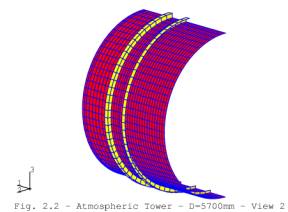
This picture shows the result of out of roundness analysis for a
φ=5700 mm thin walled shell column supported in the horizontal
position during hydrostatic test. The support saddle has been modelled by
restraining all the shell nodes located along the saddle by means of
unilateral gap elements acting in the radial direction. The external
stiffening rings have been considered in the model to minimize out of
roundness effects during water filling.
|
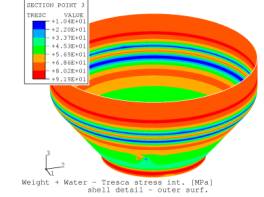
This is an ABAQUS model of a φmax=6370
mm conical reduction, for which  provided the design
basis ASME stress analysis for a large manufacturer. The column
support skirt is welded to the conical reduction. Because of the column
height, pressure stresses were excessively high in the hydro test
condition, and traditional vessel design software was not well suited to
the task. Several analysis iterations and physical modifications
were evaluated before converging on this arrangement, which meets all VSR
ed. 99 material stress limits, although a Division 2 design by analysis
approach was utilized. provided the design
basis ASME stress analysis for a large manufacturer. The column
support skirt is welded to the conical reduction. Because of the column
height, pressure stresses were excessively high in the hydro test
condition, and traditional vessel design software was not well suited to
the task. Several analysis iterations and physical modifications
were evaluated before converging on this arrangement, which meets all VSR
ed. 99 material stress limits, although a Division 2 design by analysis
approach was utilized.
|

This picture shows the result of evaluation of stresses on so
called “hard points”, for an atmospheric storage tank. The
objective of the analyses is to assess the compliance of the stiffeners
and plates with ASME VIII DIV.2 code prescribed stress limits.
|

